



Introduction
Teams often confuse having architecture diagrams on a wiki with having a collaborative engineering culture. An architect might have designed a system years ago, left the company, and put a couple of diagrams on a wiki as a way to document and “transfer” their knowledge to other engineers. It doesn’t explain the historical decisions, their thought process, or any reasoning why things work the way they do.
At IcePanel, we believe in a progressive architecture. This means that architecture is in a constant state of evolving to meet the demands of the business: new customer requirements, new markets, product launches, acquisitions, etc. For architects, that translates to system migrations, scaling, deprecations, and new system designs.
Documenting an architecture is a point-in-time snapshot that loses context and gets outdated over time. You can document the architectural decisions in ADRs, but ideally, it’s better to collaborate on a dynamic view of the architecture without losing context. A whiteboard session is a perfect example of collaboration and of understanding the reasoning behind the architecture.
Sure, having diagrams in meetings and design documents is great for planning and discussion. But they don’t capture the thought process that went into designing these systems. Very much like coding interviews, interviewers focus on understanding the candidate’s thought process while solving a coding problem, more than accepting the code as an output. The same applies to architecture design and modelling.
Diagrams should be a vehicle for thinking, whiteboarding, and shared understanding. Not auto-generated wiki artifacts. AI can easily generate those artifacts, but what engineers and architects actually care about is the human reasoning behind the design. The ‘why’ behind the decisions.
For example, if I give you an architecture diagram for an AI voice agent with audio streaming, LLM calls, and storage, you’d have questions about things like security, storage, and performance. These can all be discussed in a collaborative space for knowledge sharing, rather than just being written down as a documentation piece.
Why a single diagram doesn’t work
One reason diagrams fail as documentation is that they try to serve everyone with one view, frontloading the full context to all stakeholders: product, engineering, finance, and operations. But different audiences have different needs from the same architecture.
For example:
- Product needs to understand the system’s functionality and limitations. What the customer onboarding flow looks like. What customers actually use and need. This helps define product roadmaps.
- Engineers and architects need a deep understanding of the functional and non-functional requirements of the system. How data flows between components. How services talk to each other and what external systems we currently integrate with.
- Finance needs to understand the system’s cost allocation. Which services drive the most infrastructure spend? Where the budget goes across the architecture.
- Security needs to understand the attack surface of the system. Which data flows carry sensitive data (like customer PII, banking details, etc.). Which services are externally facing (e.g., via internet gateway) and what third-party dependencies introduce risk. Having this context in a separate diagram works well with evaluating the architecture as a whole from an engineering and security standpoint.
This is an example of four different audiences, all needing different views of the same architecture. Merging all of them in a single diagram won’t work and will cognitively overload individuals, who are only looking for specific aspects of the architecture. Having multiple diagrams is better. It is also easier when diagrams are generated from a shared model rather than drawn independently and maintained as separate views (and contexts).
Lack of collaboration = cognitive debt
In software development, technical debt refers to the accumulation of implementation shortcuts that make software harder to understand, modify, or extend over time. But there’s a less talked-about counterpart that’s arguably more dangerous: cognitive debt.
Cognitive debt is a new term that highlights the growing gap between how much of your system exists and how much of it any human being genuinely understands. It’s the knowledge that lives in people’s heads rather than in shared artifacts. When those people leave, change teams, or simply forget, the debt compounds.
Technical debt is visible and easy to measure: slow CI/CD pipelines, old dependencies, unrefactored code. However, cognitive debt is quieter. The codebase looks clean, tests are passing, and diagrams exist in a wiki page. But nobody can explain why the system was designed this way, what trade-offs were made, or what would break if you changed it.
An architect’s worst nightmare is working with “black-box” architectures, where a small change can break an entire system without explanation.
Cognitive debt affects both architects and software engineers. Anthropic’s research on AI-assisted coding found that engineers who used AI for code generation scored 17% lower on comprehension tests compared to the control group. The largest drops were in debugging and code reading.
Another study by MIT’s “Your Brain on ChatGPT” found a similar pattern: writers leaning on AI exhibited reduced neural connectivity and weaker memory of what they’d just produced.
Diagrams without collaboration make this worse. If an architect attaches some diagrams without the discussion that shaped them, they’ve documented the output but not the understanding. The next engineer who reads it inherits the diagram but none of the reasoning.
Architecture slop
Architecture slop is when AI generates diagrams without business context or human review. AI can generate clean-looking diagrams and confident-sounding architectural recommendations. But if nobody on the team formed an independent view of the design, nobody reviewed the trade-offs, and nobody questioned the assumptions, then the output is slop regardless of how polished it looks.
The process looks like this:
- An architect is tasked to design some system.
- Prompts AI directly to design it.
- AI generates an architecture diagram (looks polished and detailed).
- The architect submits it to the engineering team for implementation without review.
- Cognitive debt (nobody understands why it is designed this way).
For example, I asked Claude to design an e-commerce platform. Here’s the output:
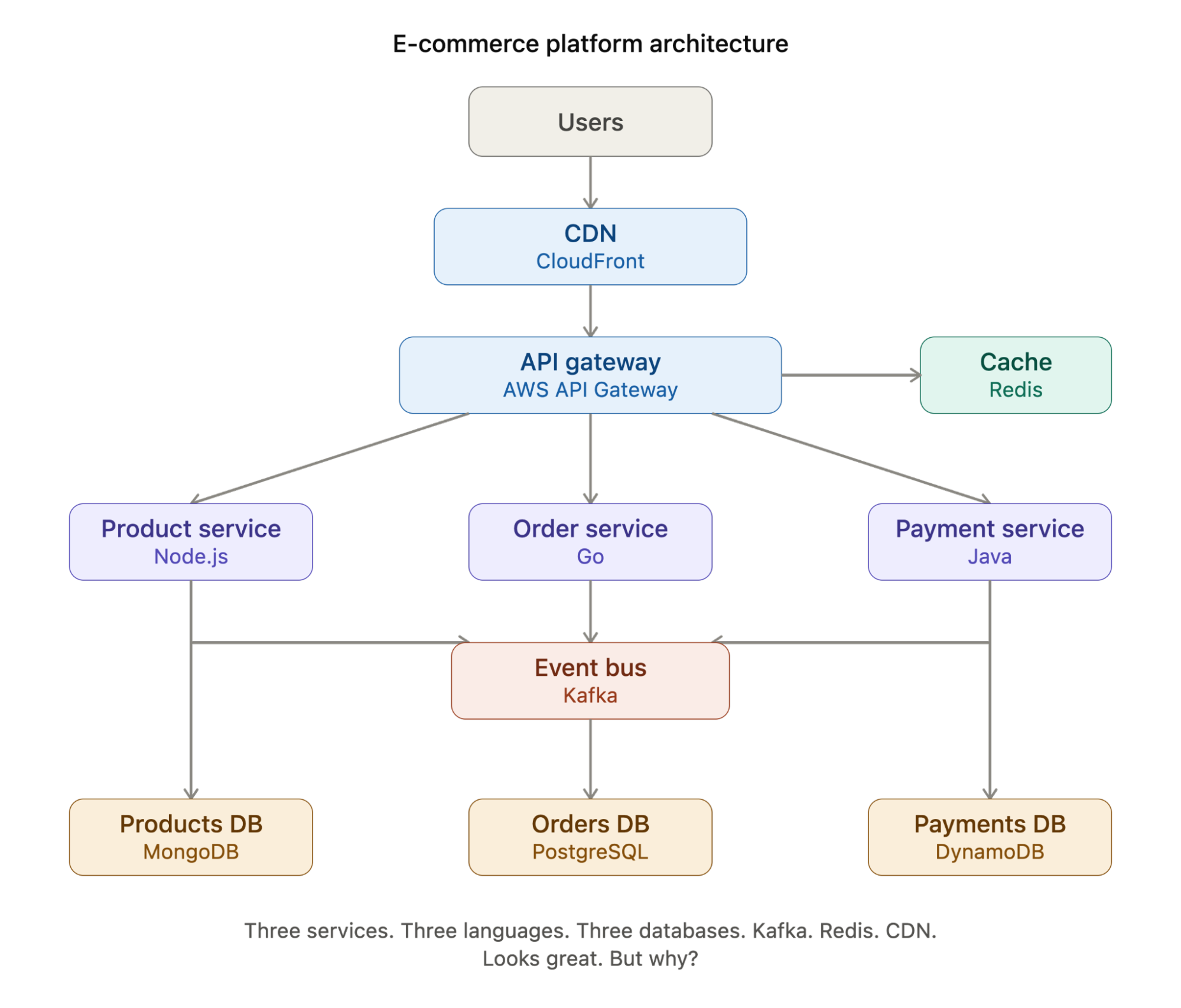
This is a clean-looking architecture slop. Even though the diagram looks detailed with named technologies and clear data flows. But look at the decisions it made without explaining why:
- Why three different languages (Node.js, Go, Java)?
- Why three different databases? Where is the data model? What drove each choice?
- Why Kafka? Why not SQS?
- Why microservices in the first place? Why not monolith?
That’s the difference between an architecture designed collaboratively with shared understanding and an architecture slop. The slop might look passable for documentation purposes, but it tells nothing about the engineering decisions, business context, and human experience.
So, what should diagrams actually be
We talked about the old versus the new world of architecture in our IcePanel vision. The old world has static diagrams, documentation as output, and architects as gatekeepers. We see the new world of architecture that is: continuous, collaborative, evolutionary, and decision-first.
Diagrams are views drawn from a living system that can serve any type of audience.
Platform engineers can have diagrams for the infrastructure they’ve built. Product engineers can have diagrams for the services they’ve designed. Others can have diagrams for different purposes. All of these diagrams come from the same source of truth, one up-to-date architecture.
The point isn’t that diagrams are useless (the ones without shared context are). Engineers prefer to work together and understand the systems they’re maintaining rather than inheriting diagrams that were documented for the sake of documentation. Good architecture diagrams are built from shared context, kept current as systems evolve, and have views for different audiences.
Conclusion
Documenting architecture diagrams doesn’t mean your team understands the system. There are layers of data flows, integration boundaries, and design trade-offs between services that a single diagram can’t capture without the context of why it was designed that way.
Architecture diagrams are valuable when they’re a product of collaboration: discussed, debated, and refined by the people who build and maintain the system.