


Introduction
Architects carry a significant responsibility when designing systems. Whether it’s a small startup building a monolith or a large enterprise managing a complex architecture with hundreds of services, the core challenge is the same: design a set of interconnected services that work together to deliver value to customers.
Architects approach this with domain expertise and deep technical knowledge. They know which databases handle which workloads (write-heavy vs read-heavy), when to use (a)synchronous processing, and are deliberate with their design trade-offs, like consistency and availability. That knowledge and experience are essential, but not always enough.
What’s missing is a structured way of thinking about the system as a whole (and possibly sub-systems within). Not just focusing on individual services, but how they interact, how they respond to change, and why they behave the way they do over time. This is where Donella Meadows’ systems thinking work becomes relevant.
Donella Meadows was an environmental scientist and systems analyst and her book Thinking in Systems is one of the best resources on understanding complex systems. She wasn’t a software architect, she was writing about economies and ecosystems, but the principles she describes apply directly to what architects do every day. In this post, we’ll explain how Meadows’ work can benefit architects and structure their systems thinking.
Thinking in systems 101
According to Meadows’ definition, a system is an interconnected set of elements that is coherently organised to achieve something. Every system relies on three core components:
1) Elements are the visible parts (actors) of the system. These could be services, databases, caches, and 3rd-party integrations.
2) Interconnections are the relationships, flows of information, rules, or links that tie elements together. These could be HTTP calls, event streams, and config files. Two services might not call each other directly but share a database, making them coupled in ways that might not be clear.
3) Function (or purpose) is what the system actually does (not the intention). Meadows clarifies that a system’s function is revealed by its behaviour, not by its stated intentions. For example, if an e-commerce system is designed for high availability but goes down on Black Friday, its actual function is failing under peak load (even though the intention is to operate at any scale).
Beyond these three components, Meadows introduces two core concepts that are especially useful for architects.
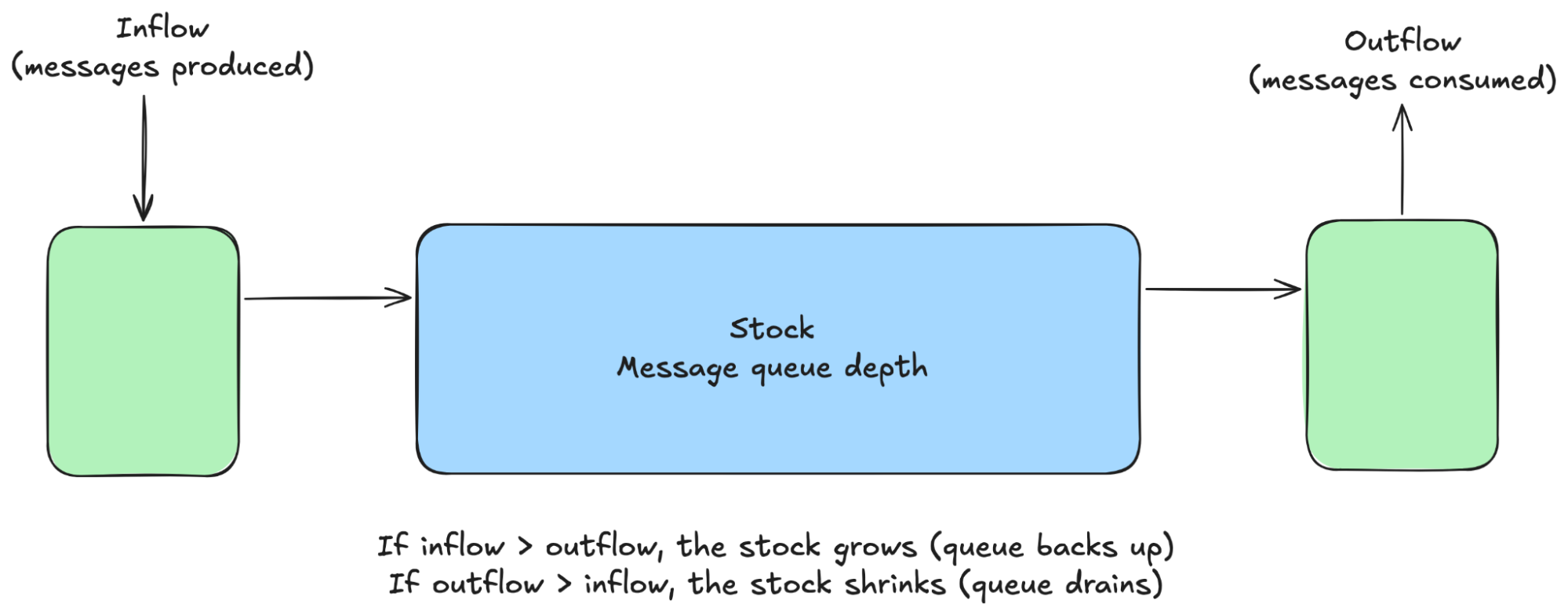
1) Stocks and flows. Stocks are anything in the system that accumulates over time. In software architecture, this could be a message queue depth, database load, memory usage, etc. Flows are the rates of change for stock: messages produced (inflow) and messages consumed (outflow). Architects should focus on both flows (how data moves) and stocks (what accumulates).
Here’s how stocks and flows work:
2) Feedback loops are when a change in a stock affects the flows that change that stock. There are two types of loops:
- Balancing loop that stabilises the system (e.g., rate limiters and autoscalers).
When CPU usage increases in a single service, the autoscaler adds instances to help normalise average CPU usage and stabilise the system. Architects can think about load balancers, circuit breakers, and rate limiters as balancing loops.
- Reinforcing loop that destabilises the system (e.g., cascade failures and unbounded queue growth).
When a service is overwhelmed by client requests, it slows down, so clients retry requests, slowing the service further, and keep retrying until the service goes down. This is an example of a system destabilising and cascade failures.
Meadows also talks about delays: the time between when a flow changes and when the stock responds. In software, this is the request latency or the time between triggering an event (e.g., publishing a task to a queue) and seeing its response (e.g., worker picking up the task from the queue).
To make these concepts concrete, let’s take a system design problem as an example below.
Practical example: designing an AI voice agent
Let’s take a design problem and approach it with systems thinking. Say you’re an architect asked to design an AI voice agent with one functional requirement: real-time conversational AI.
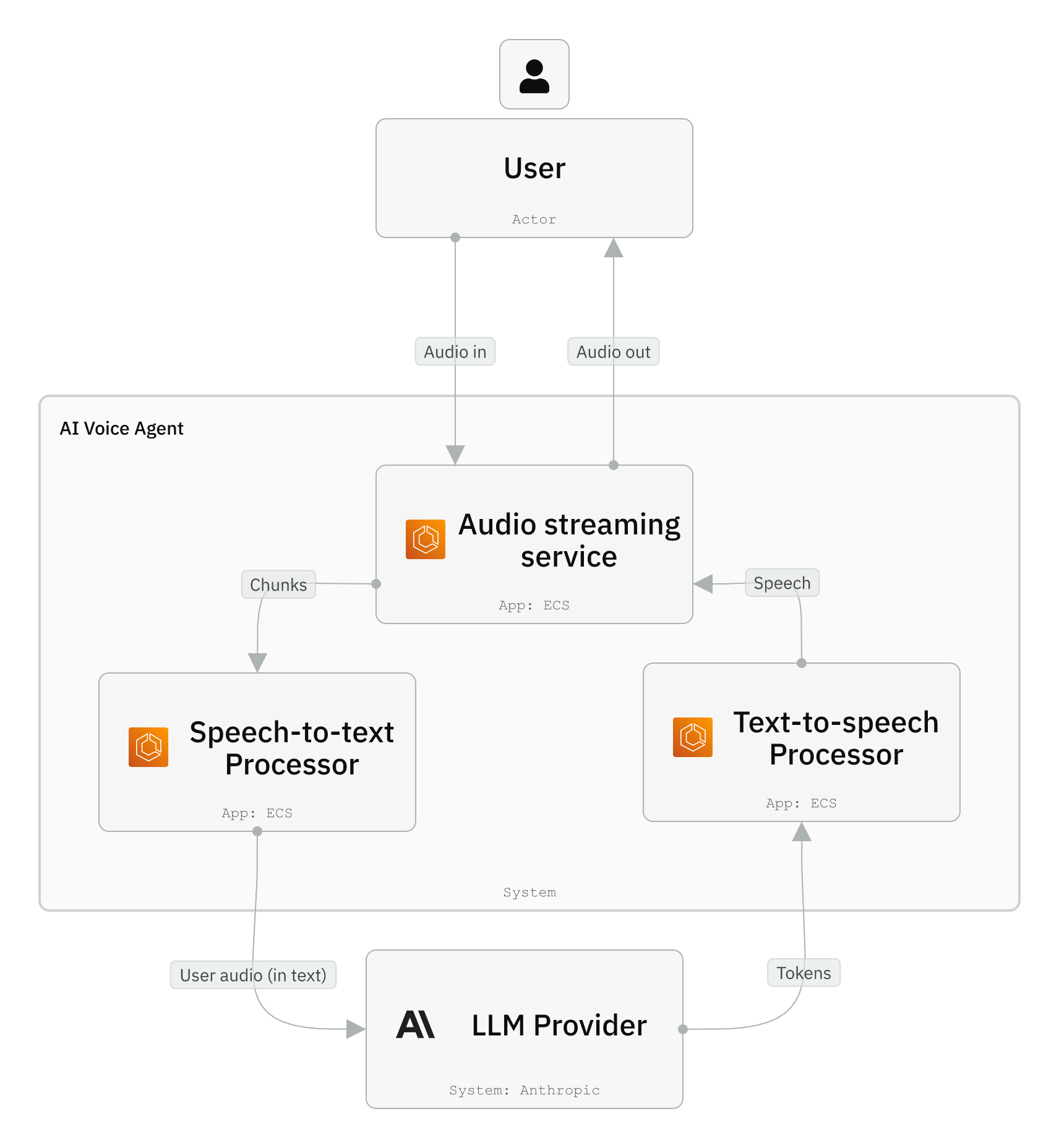
As an architect, you’ll break down the problem with that one functional requirement. The system needs to handle audio streaming from users, process speech-to-text, send prompts to an LLM, convert responses back to speech, and stream the audio back in real-time. Here’s a high-level architecture below:
Here’s how systems thinking helps structure the design:
- Identify the elements: the user (actor), audio streaming service, speech-to-text processor, the LLM, the text-to-speech processor, and the audio output stream. External elements can include the LLM provider (e.g., Anthropic or OpenAI).
- Map the interconnections: The user connects via websockets to the audio streaming service. The streaming service sends audio chunks to the speech-to-text processor. The transcribed text flows to the LLM. The LLM response flows to the text-to-speech processor. The synthesised audio flows back through the streaming service to the user.
- Define the function: The core functional requirement is having a real-time conversational AI, at any scale. According to Meadows’ definition, the function will be determined by what the system does under load and under edge cases (e.g., background noise), not the intended behaviour.
- Identify the stocks: The audio buffer, LLM token usage, active concurrent sessions, are all considered stocks. Each of these stocks can accumulate and need to be monitored.
- Identify the flows: The audio chunks flowing in from audio streaming service, transcribed text flowing to the LLM, LLM tokens being generated, are all considered flows. The rate of each flow determines whether the stocks stay stable or grow unbounded.
- Identify the feedback loops: If latency increases (stock: buffered audio grows), the user might repeat themselves, adding more audio input, creating an overall bad user experience. That’s a reinforcing loop making latency worse and destabilising the system. On the flip side, a balancing loop can be an adaptive solution that reduces audio quality to process faster in case the audio buffer grows too large.
An architect without systems thinking would have designed this architecture and left it at that. But they wouldn’t have identified the audio buffer as a stock worth monitoring, the LLM latency as the critical delay, or the user-retry pattern as a reinforcing loop. Those are the things that determine whether the system can scale under high traffic or break down.
This was an example of systems thinking when building an AI voice agent. Here’s how to apply it more broadly.
How architects should apply systems thinking
1. Think about container diagrams like stock-and-flow diagrams.
In the C4 model, a container diagram highlights the core services (components) and how they interact with each other. A stock-and-flow diagram shows the accumulation of elements (user requests) and at what rate they move between services (request rates). This helps architects to identify chokepoints, especially when integrating new services or coordinating feature releases.
2. Think about delays and feedback loops
Every balancing loop in your system (autoscalers, circuit breakers, rate limiters) has a delay between trigger and response. If the autoscalers take a few minutes to add instances but traffic spikes overwhelm the system in seconds, the balancing loop is too slow. Being aware of the delays and how fast or slow loops stabilise the system is a strong leverage point for architects.
3. Think about observability like stocks and flows
Monitoring dashboards often track flows: request rate, throughput, error rate. Fewer track stocks: queue depth over time, CPU utilisation, memory usage. Architects should think about flows as lagging indicators and stocks as leading indicators, and monitor both. For example, an incident can happen because a service’s error rate spiked (flow) because the dependent message queue has been accumulating messages for over 30 minutes (stock).
These three lenses (stocks and flows, delays, and feedback loops) give architects a structured way of thinking to ask better questions about their systems and better collaborate with their stakeholders.
Conclusion
Architects design and maintain systems every day. They already have some systems thinking. However, Meadows’ book helps add a structure and a set of patterns for doing it more deliberately.
Here’s a thought exercise: next time you’re reviewing an architecture diagram, ask: where does the traffic accumulate in your system? What happens when inflow exceeds outflow? Where are the chokepoints in the architecture, and where are the delays that could turn high latency into an incident?
Being good at asking those questions is a strong signal you’re a systems thinker.